
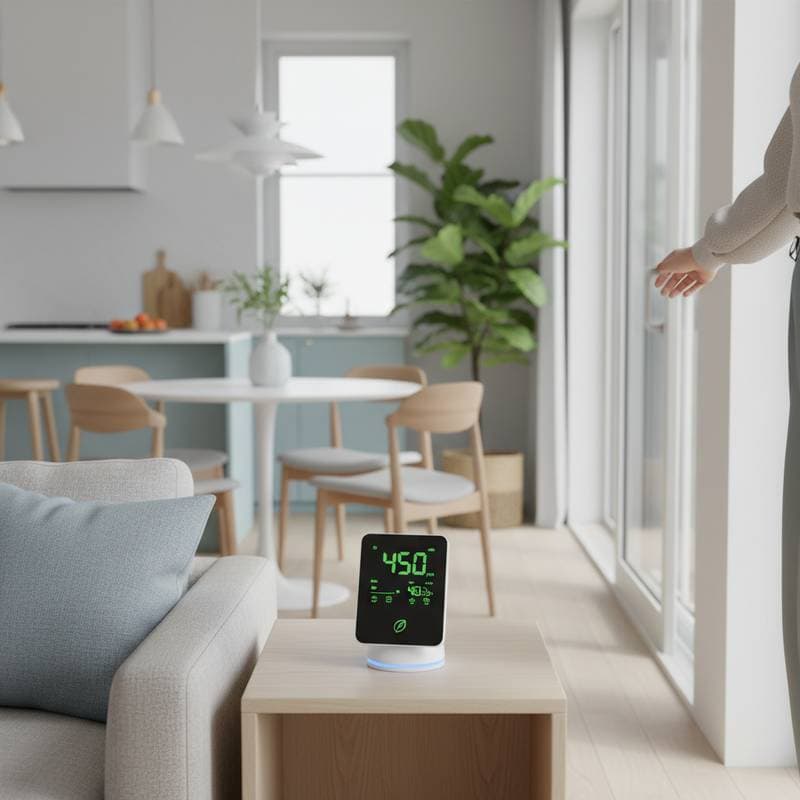
Why CO2 Monitors Serve as Essential Tools for Home Air Quality
Homes provide shelter and security, but indoor air can subtly affect daily energy and mood. Symptoms such as headaches, tiredness, and midday lethargy may stem from more than inadequate rest or fluid intake. Elevated carbon dioxide levels often contribute to these issues. CO2 monitors, previously common in labs and educational settings, now equip households with data that human senses overlook. These tools illuminate a critical element of indoor health and comfort.
Key Details at a Glance
- Primary users: Homeowners, renters, parents, remote professionals, and individuals focused on indoor wellness
- Common placement areas: Living rooms, bedrooms, home offices, and educational spaces
- Dimensions: Ranging from portable pocket units to wall-mounted devices approximately 4 by 4 inches (10 by 10 centimeters)
- Core technology: Infrared sensors or non-dispersive infrared (NDIR) detection systems
- Price range: Basic models from 40 to 100 USD; premium versions from 150 to 400 USD
- Installation duration: Typically less than 10 minutes
Transforming Readings into Everyday Improvements
A CO2 monitor makes the unseen tangible. Many units feature color-coded screens or mobile applications that display air quality instantly. Green or blue signals indicate safe levels under 1000 parts per million. Yellow alerts point to moderate accumulation, and red flags signal the need for immediate ventilation. This straightforward system prompts practical responses, such as opening a window, activating a fan, or modifying heating, ventilation, and air conditioning settings.
Position a small unit on a desk or shelf to observe daily fluctuations. Several models log data over periods, highlighting shifts during closed-door scenarios, meal preparation, or group gatherings. Such patterns enable precise adjustments to airflow routines. For instance, ventilating for five minutes hourly maintains low CO2 without significant winter heat loss.
The Impact of CO2 Levels on Health and Concentration
CO2 concentrations exceeding 1000 parts per million often lead to drowsiness and reduced focus. At 2000 parts per million, the atmosphere feels dense and outdated, triggering headaches, lightheadedness, or frustration. This occurs because elevated CO2 reduces oxygen access, impairing cognitive performance and vigilance.
In households, high levels contribute to disrupted sleep and irritable mornings. Remote professionals experience diminished output without clear reasons. A compact digital device links these effects to environmental factors, clarifying that the issue lies in the surrounding air rather than personal shortcomings.
Parents observe pronounced effects in children's spaces. Monitors detect rapid overnight increases in sealed bedrooms. Slight window openings or silent exhaust fans lower these levels substantially, improving rest for all occupants.
Affordable Choices Tailored to Household Needs
Tracking air quality requires minimal investment. Basic CO2 monitors below 100 USD provide dependable measurements. Prioritize units with NDIR sensors and periodic calibration options for accuracy.
For smartphone integration, consider mid-tier devices like the Inkbird IAM-T1 or Temtop M2000C, which offer mobility and app features. Advanced systems include humidity and particle detection for comprehensive air analysis.
Practical Storage and Maintenance Tips
- Maintain portability by shifting the device between rooms for comparative assessments.
- Position away from direct sunlight or heat sources to ensure precise data.
- Recharge batteries or replace them routinely, since depleted power compromises sensor performance.
Perspectives from Design Experts
Air quality professionals liken CO2 monitors to temperature gauges. Individuals check thermometers before altering climate controls; similarly, these monitors indicate when fresh air is required. Environmental designer Lena Krüger notes, "We used to rely on how air feels, but that is misleading. Once you see the numbers, you realize how fast CO2 builds up in daily life. The data encourages mindful habits."
Designers and architects incorporate CO2 considerations into spatial planning. They position vents adjacent to workstations, include adjustable bedroom windows, and select permeable furnishings to promote circulation. Simple upgrades, such as installing narrow vents over windows, yield significant enhancements.
Adopting CO2 Awareness for Sustained Home Wellness
Monitoring CO2 integrates seamlessly into routines, prompting reflections on circulation. The device functions as a subtle guide, suggesting window adjustments or brief outdoor breaks. Gradually, spaces feel revitalized, and vitality stabilizes. This practice extends to related actions, such as evaluating moisture levels or servicing filters more consistently.
The approach emphasizes observation over complexity. Individuals organize spaces or modulate illumination for ambiance; they can apply similar attention to air management. A display showing green readings on a desk or nightstand confirms a nurturing, oxygen-rich environment.
Regardless of residence size, from modest apartments to spacious homes, a CO2 monitor delivers straightforward environmental awareness. It empowers informed decisions that accumulate into enduring health benefits. Access to pure air becomes attainable through basic sensing technology.