
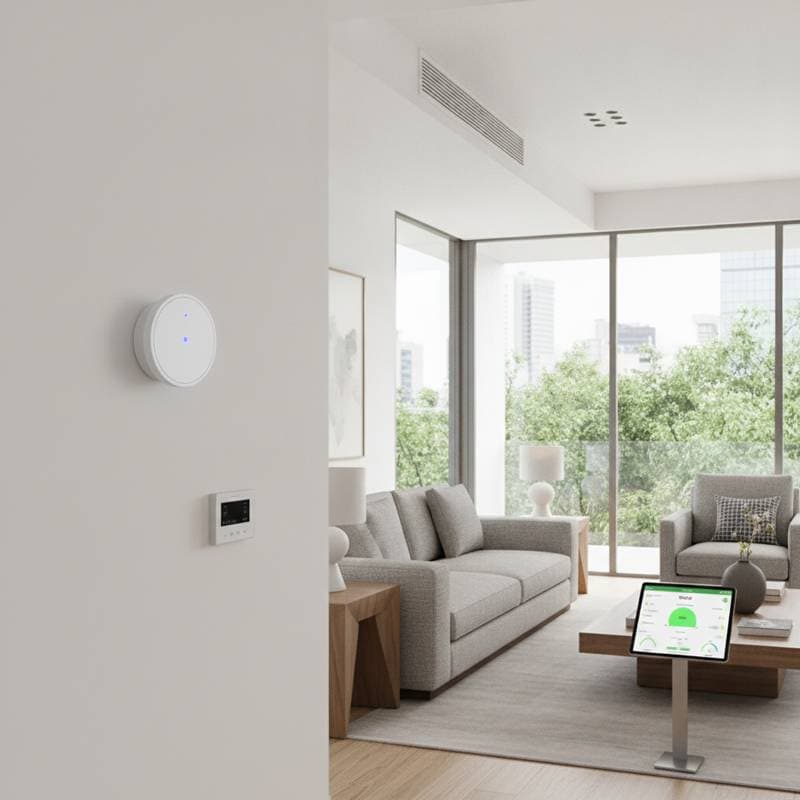
Why Modern Homes Need CO2 Sensors for Healthy Air
We spend most of our time indoors, often with windows closed to save energy or reduce noise. Every exhaled breath releases carbon dioxide. Without proper ventilation, concentrations rise quickly. Levels above 1000 parts per million often produce fatigue, headaches, and reduced focus.
Older homes allowed natural air exchange through gaps in walls and joints. Modern airtight construction eliminates that leakage. Ventilation must now be managed deliberately. CO2 sensors provide the simplest reliable method to trigger fresh air when needed.
Key Details at a Glance
- Builders, homeowners, and tenants in new energy efficient housing
- Regions that adopt updated ventilation codes
- Living rooms, bedrooms, and central return ducts
- Integration with mechanical ventilation or smart HVAC controls
- Cost range of 60 to 250 euros per unit
Why CO2 Serves as the Practical Benchmark
CO2 acts as a reliable proxy for occupancy and ventilation performance. Elevated readings signal that a space is occupied yet under ventilated. Unlike many other pollutants, CO2 can be tracked accurately with affordable digital sensors suitable for automation.
Updated building codes require demand controlled ventilation. Airflow now increases only when sensors detect rising concentrations. When rooms empty, the system reduces fan speed. This approach maintains air quality while lowering energy use.
Daily Benefits for Occupants
A calibrated sensor manages air changes automatically. Families report fresher mornings, fewer headaches, and reduced stuffiness. Students maintain better concentration. Parents gain reassurance that bedrooms receive adequate fresh air overnight.
Sensor Technology and Installation
Most units rely on nondispersive infrared measurement. An infrared beam passes through an air sample and the sensor calculates absorption by CO2 molecules. Many models also report temperature and humidity.
Mount sensors at breathing height between 1.2 and 1.8 meters. Avoid corners, doorways, and direct proximity to vents. In homes with mechanical systems, sensors connect to the central controller to adjust fan speeds automatically. Wireless units link to smart home platforms for remote monitoring and alerts.
Design and Budget Considerations
Manufacturers offer wall mounted units with matte finishes and compact tabletop models with wood or metal accents. Hardwired installation during construction conceals cables for a clean appearance. Budget plug in models deliver comparable accuracy and can send alerts via Wi Fi.
A typical single family home needs two or three sensors. Total cost remains modest compared with other upgrades. Occasional calibration or replacement after several years constitutes the only routine maintenance. Some municipalities offer incentives that offset part of the expense.
Integration Without Visual Clutter
Designers conceal sensors behind perforated panels or within existing outlet modules. Standardized mounting points installed during framing keep devices unobtrusive. Renters can use portable units to test multiple rooms and identify problem areas such as blocked vents.
Connection to Sustainability Goals
CO2 monitoring supports both energy efficiency and occupant health. Airtight construction reduces heating and cooling loads, yet it requires active ventilation management. Sensors close that gap by tying airflow directly to measured conditions.
Homeowners who view real time data become more aware of how cooking, cleaning, and occupancy affect air quality. This visibility encourages practical adjustments that reinforce sustainable habits.
Living With Responsive Air Quality
Once installed, the devices operate quietly in the background. Rooms stay fresher, alertness improves, and the home adapts when occupancy changes. Builders demonstrate commitment to health and precision. Homeowners receive objective confirmation that modern efficiency supports well being. Fresh air becomes a built in feature rather than an afterthought.