
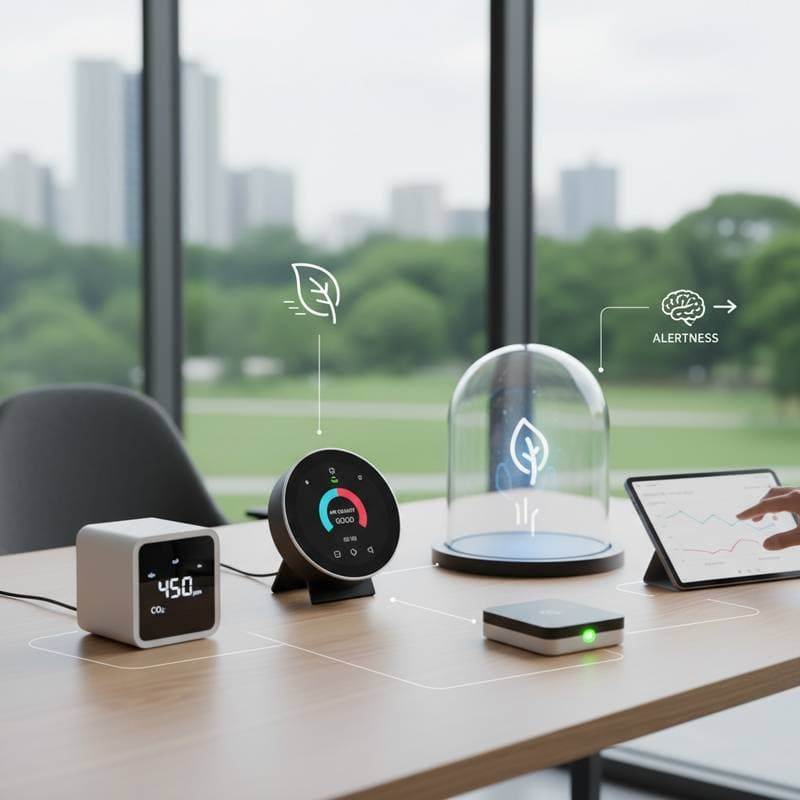
CO2 Sensors Improve Indoor Air Quality and Alertness
Poor ventilation in offices and classrooms often leads to elevated carbon dioxide levels. These conditions trigger drowsiness, headaches, and lapses in focus. CO2 sensors now appear in many modern buildings because they track gas concentrations and prompt timely ventilation adjustments.
This guide examines how these devices support healthier indoor environments. It also presents tested models across price ranges and supplies criteria for selecting suitable units.
Evaluation Criteria and Testing Approach
We assessed multiple sensors for measurement precision, response speed, user interface quality, and long-term reliability. Each unit operated in spaces with controlled and variable airflow. Readings were cross-checked against calibrated reference instruments.
Additional factors included display visibility, power requirements, calibration procedures, and integration options with ventilation controls. Devices that supplied consistent data and supported practical interventions received higher priority.
Recommended CO2 Monitoring Devices
Top Overall Choice: Airthings View Plus
This model delivers laboratory-grade accuracy across CO2, humidity, temperature, and particulate readings. Its mobile application displays historical trends and issues alerts when thresholds are crossed. Battery operation and wall-mount hardware simplify installation in homes or shared rooms.
Users accept the higher cost because the multi-parameter data supports informed decisions about airflow management.
Strong Value Option: Temtop M10
The Temtop M10 provides dependable CO2 measurements in a compact, battery-powered package. A single-button interface and clear screen suit small apartments or workspaces that need basic monitoring without wireless features.
Its portability allows quick checks across different rooms, although response time lags slightly behind premium units during sudden ventilation changes.
Advanced Connected Model: Awair Element
The Awair Element measures volatile organic compounds alongside CO2, temperature, and humidity. It connects to Wi-Fi networks and smart-home platforms, enabling automated ventilation responses. Continuous power is required, yet the detailed app recommendations justify this requirement for technology-oriented users.
Professional Environment Solution: Netatmo Smart Monitor
Facilities managers value the Netatmo unit for its stable readings of CO2, humidity, temperature, and ambient noise. The companion application logs data over time and sends notifications when concentrations rise. Calibration at setup ensures reliable performance in larger offices.
Portable High-Accuracy Unit: Aranet4 Home
Battery-powered operation and Bluetooth connectivity make the Aranet4 suitable for users who move between locations. Rapid display updates and straightforward data export help identify rising CO2 levels during travel or room transitions.
Selection Factors for Reliable Performance
Prioritize sensors that state their measurement range and accuracy tolerance. Nondispersive infrared technology generally yields stable results over months of use. A built-in calibration routine further preserves precision.
Wireless connectivity allows remote tracking and threshold alerts through smartphone applications. Cloud storage proves useful when data from several rooms must be reviewed together.
Clear visual indicators or audible signals enable fast reactions in busy settings. Battery models offer placement flexibility, while mains-powered units eliminate periodic replacements.
Many devices also report humidity and temperature. These additional readings clarify overall comfort and guide adjustments beyond CO2 control alone.
Durable construction protects internal components from temperature swings and daily handling. Choose units with solid enclosures when placement occurs in high-traffic areas.
Sustaining Healthy Indoor Conditions
Regular sensor placement near seating areas captures representative air samples. Scheduled ventilation or mechanical system activation keeps concentrations within recommended limits. Consistent monitoring supports sustained concentration and reduces fatigue across workdays and study sessions.