
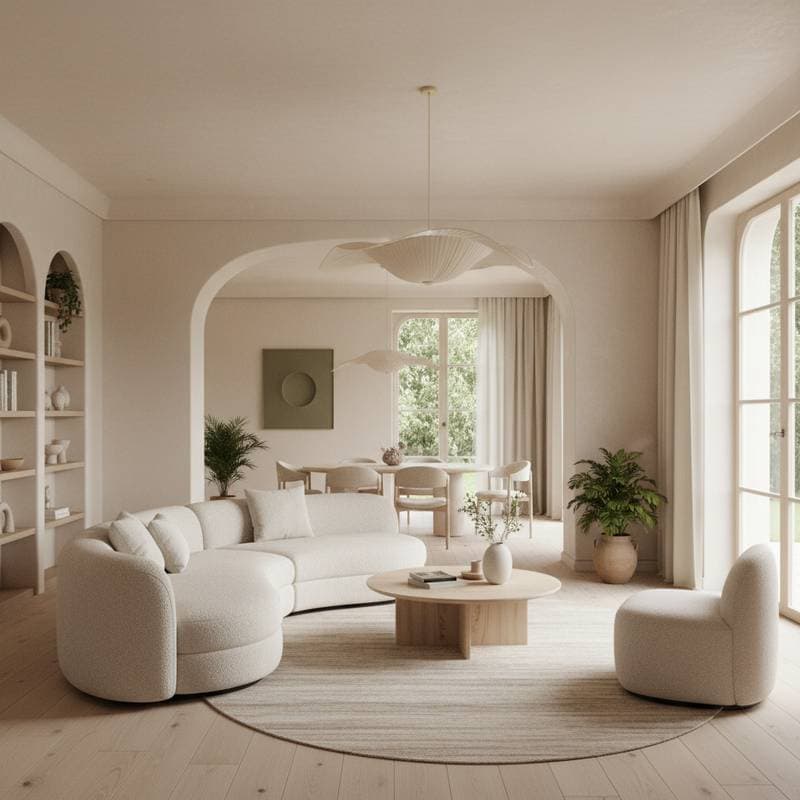
Why Homes Are Embracing Curves Over Sharp Angles
Step into a newly designed home today, and the change is evident. Sharp lines that once characterized modern interiors now yield to softer, rounded forms. Sofas feature gentle bows rather than square edges, dining tables adopt pill-like shapes, and built-in elements include rounded corners. This shift toward curves represents more than a fleeting style; it reflects a desire for spaces that feel calm, inviting, and authentically human.
The Resurgence of Curved Forms
Curves have appeared throughout design history, yet their current prominence carries fresh significance. Minimalism long favored hard geometry for its efficiency and precision, but many now perceive those straight lines as cold and unyielding. Rounded shapes provide a counterpoint, delivering softness that aligns with contemporary modernity.
Design consultant Lena Hartmann observes that curved furniture alters movement and interaction in a room. "When a sofa has a rounded back or a coffee table features smooth edges, people naturally relax their posture," she states. "Curves encourage conversation and convey comfort before anyone sits."
This instinctive response drives the prevalence of organic shapes. Gentle arcs in headboards or subtle bends in kitchen islands introduce ease that rigid structures lack.
The Appeal of Softer Contours
A home extends beyond visual appeal; it shapes emotional experience. After hours amid screens and structured settings, individuals seek interiors that offset that rigidity. Rounded forms draw from nature, resembling river stones, tree trunks, or rolling hills, which infuse rooms with vitality rather than mechanical precision.
Experts in environmental psychology indicate that curved lines appear safer due to the absence of sharp edges. The brain processes them as approachable, reducing stress levels. Introducing a single curved element, such as a circular rug in a rectangular living area or an oval mirror in a compact bathroom, can transform the room's atmosphere.
Applications Across Design Elements
Curves extend beyond furniture to influence architecture, lighting, and accessories at various scales.
Arches and Doorways:
Rounded entrances reemerge as understated features that divide spaces without isolation. They frame vistas like natural artwork and facilitate smooth transitions between areas.
Sofas and Seating:
Living rooms showcase the trend prominently. Crescent sectionals, barrel chairs, and curved chaises supplant boxy designs, promoting adaptable arrangements and conversational groupings over fixed configurations.
Tables and Consoles:
Dining tables with softened corners ease navigation in confined spaces. Half-moon consoles align flush with walls, suiting narrow hallways or compact apartments without intrusion.
Lighting:
Orb-shaped pendants, mushroom-style lamps, and dome sconces provide both functional and ambient warmth. Their rounded profiles distribute light uniformly, avoiding stark shadows.
Decor and Accessories:
Round vases, wavy mirrors, and irregular handmade ceramics embrace imperfection. Organically shaped trays further emphasize natural ease.
Complementary Materials and Palettes
Shape contributes to softness, but materials amplify the effect. Velvet, boucle fabric, and linen introduce tactile richness that pairs seamlessly with curves. In kitchens and bathrooms, matte finishes and honed stone temper reflections while ensuring resilience.
Designers integrate sustainable options with organic forms. Reclaimed wood, lime plaster, and clay paints align through their earthy essence. Light on a rounded plaster wall produces a soft glow, fostering a serene, rooted ambiance.
Muted color schemes enhance cohesion. Warm neutrals, clay pinks, and sage greens harmonize with curved rhythms, allowing shapes to dominate without overwhelming the palette.
Incorporating Curves Without Overhaul
Major renovations prove unnecessary to adopt this trend. Simple adjustments yield significant impact.
Begin with Modest Additions:
Select a circular side table or curved lamp base. One such element softens a room's severity.
Replace Angular with Rounded Floor Coverings:
Exchange a rectangular rug for a round or oval version. This adjustment redefines furniture placement and can make small areas appear larger.
Simulate Arches Through Paint:
Apply a curved motif behind a bed or entry to evoke architectural depth without alterations.
Opt for Rounded Fixtures:
Choose circular or oval cabinet knobs, faucet handles, and mirror frames to subtly reinforce the motif.
Balance with Linear Elements:
Curves gain prominence alongside structure. Combine a curved sofa with a rectangular coffee table or a round dining table with straight-backed chairs for clarity.
Affordable Strategies for Curved Design
High costs need not deter adoption. Retailers provide budget-friendly rounded options, including upholstered ottomans with soft edges or modular units simulating custom curves.
Vintage sources like thrift shops and online platforms yield treasures such as mid-century tulip tables or art deco mirrors, blending history with sustainability. For hands-on approaches, sand sharp corners on a wooden side table or add rounded trim to shelves for transformation.
Lighting serves as an economical starting point. A dome pendant or globe lamp introduces curves with minimal expense.
Case Studies from Real Interiors
In a tight urban apartment, designer Malik Ortega revamped a narrow living space by installing a curved sectional and round ottoman in place of a stiff sofa and rectangular table. Flow improved, and openness increased. "The old arrangement confined people to edges," Ortega noted. "Curves enable seamless movement and dialogue."
Homeowner Dana Lin sought warmth in her suburban kitchen. She updated the sharp-edged island to one with radius corners and added a semi-circular banquette. Safety rose for her children, and the space soothed visually. "It envelops us during breakfast," Lin shared.
Practical Designer Perspectives
Efficient Storage Solutions:
Rounded built-ins maintain functionality. Custom cabinets with curved ends minimize visual interruptions and enhance navigation in compact zones. A convex corner shelf maximizes utility without wasted space.
Key Considerations:
Curved items may require more floor space, so precise measurement is essential for larger pieces like sectionals. In smaller rooms, select designs with open bases or slim legs to preserve airiness amid trade-offs.
Cost Analysis:
Curved sofas vary by material; polyester boucle offers entry-level pricing, while wool or leather custom builds escalate. Focus budget on a focal piece, supplemented by basic accents.
Professional Rationale for Curves
Designers value curves for disrupting uniformity. Interior architect Sofia Meyer states, "Buildings often rely on straight lines, so circles introduce vital contrast and warmth." She employs curved walls or furnishings to guide focus. "Eyes trace the form, expanding perceived room size and energy."
Curves also excel in photography, as light glides over rounded surfaces to accentuate texture and hue. This trait benefits daily living, illuminating spaces beautifully in natural light.
Emotional and Psychological Benefits
Curves connect deeply through emotion. Homes nurture comfort, and softness embodies that ideal. Rounded forms evoke touch, intimacy, and fluid motion, offering protection without weight.
In communal areas, these shapes foster closeness. A curved dining table draws participants inward for genuine exchange. Rounded countertops eliminate subtle tension from edges, refining routine interactions.
Alignment with Sustainability
This aesthetic supports enduring design. Organic shapes transcend trends, mirroring timeless natural patterns in stones, shells, and foliage. Durable curved pieces in quality materials outlast angular counterparts tied to fleeting styles.
Eco-focused professionals combine curves with renewables like bamboo, rattan, and natural latex foam. Such pairings yield furnishings that satisfy ethically and aesthetically.
Tailoring Curves to Your Environment
Curves adapt to diverse styles, from sleek apartments to cozy cottages. Proportion guides success: subtle arcs avoid clutter in tight quarters, while pronounced curves unify expansive ones.
Renters can emphasize portable items like mirrors, rugs, and lights for impact without permanence. Homeowners might explore arched niches or curved partitions for enduring softness.
Everyday Impacts of Curved Spaces
Integrating curves alters daily life subtly. Cleaning simplifies with fewer edges to snag. Furniture rearrangement gains flexibility from rounded profiles. The visual serenity promotes emotional tranquility, positioning home as sanctuary.
Pets and children thrive too: curves create inviting crevices for rest and reduce navigation hazards. This holistic calm elevates routine moments.
Personalizing the Curve Aesthetic
Embrace curves to enhance comfort and authenticity, not mimic trends. Select pieces resonant with your lifestyle.
Organic forms personalize spaces by prioritizing flow over flawlessness. They affirm that beauty arises from ease, not exactitude.
Ultimately, curves cultivate empathetic design. They recognize the human need for gentle forms and atmospheres, fostering spaces for rest, connection, and renewal.