
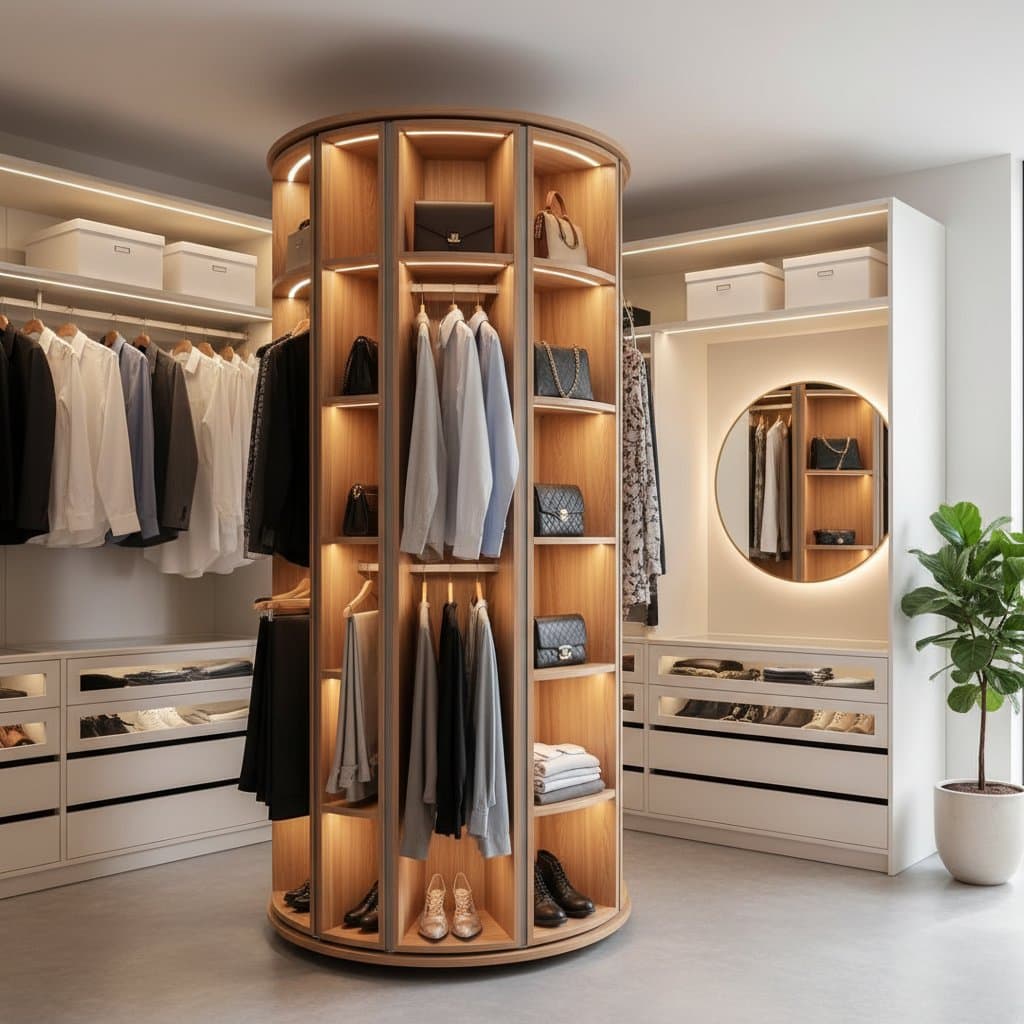
Transform overlooked corners into practical storage areas with a carousel wardrobe. These systems rotate shelves or hanging racks around a central axis, bringing items forward for effortless retrieval. Readers gain knowledge on system types, precise planning, installation processes, and professional assistance options. Steer clear of installations in humid or poorly ventilated areas to protect materials from damage.
Essential Knowledge
A carousel wardrobe functions as a revolving storage unit designed for corners or deep cabinets. It features shelves or rods that pivot on a central pole or base, operated manually or via a compact motor. Accessibility improves significantly, but installations require adequate depth and overhead clearance for complete rotation. Verify level flooring and moisture-free walls prior to starting.
Required Tools and Materials
- Tape measure for accurate dimensions
- Stud finder to identify secure mounting points
- Level to ensure even installation
- Drill equipped with screwdriver bits
- Adjustable wrench for tightening fittings
- Mounting hardware included with the unit
- Pencil and notepad for marking layouts
- Mild cleaner and soft rag for surface preparation
- Optional: compact LED light strips to enhance visibility
As an alternative to a stud finder, insert a small finishing nail to probe for solid support behind walls.
Installation Steps
1. Measure the Space
Begin by taking exact measurements of the corner area. Document the height from floor to ceiling, the depth of the walls, and the available width. Allow for a minimum of two inches of clearance on all sides to prevent contact with walls or trim during operation.
2. Select an Appropriate Unit
Choose a carousel that aligns with the corner dimensions and storage requirements. Opt for vertical models in high-ceiling closets to accommodate hanging garments. Tiered circular shelves prove ideal for folded clothing or accessories. Select metal or wooden bases for durability under heavy loads, avoiding plastic components.
3. Prepare the Area
Remove all contents from the closet or corner. Vacuum thoroughly and clean surfaces using a mild solution. Confirm the floor remains level; apply shims beneath the base if any slope exists to eliminate instability.
4. Mark Attachment Locations
Outline the positions for the central pole or base plate with a pencil. For attachments to walls or ceilings, identify studs or install blocking for reinforcement. Employ a level to align marks precisely, then verify before proceeding to drilling.
5. Secure the Base and Pole
Adhere to the manufacturer's guidelines. Typically, fasten the base plate to the floor and erect the central pole. Secure all bolts uniformly to maintain balance. Rotate the empty assembly to test for smooth operation prior to adding components.
6. Attach Shelves or Hanging Elements
Position each shelf or rod onto the pole via sliding or clipping mechanisms. Place heavier objects on lower tiers to promote stability. Customize spacing for items such as long coats or high boots, ensuring all connections tighten securely.
7. Verify Movement and Fit
Rotate the unit gradually to assess full range of motion. Reposition any elements that interfere with walls. Investigate sources of scraping sounds, which often indicate uneven setup or excessive loading.
8. Organize and Distribute Load
Arrange items to balance weight across the unit. Alternate placement between sections to prevent tipping. Proper distribution ensures fluid rotation and extends the system's lifespan.
9. Incorporate Enhancements
Install battery-operated LED strips for better illumination in shadowed areas. Select low-heat options to safeguard fabrics from damage. Clean away any residue or particles before placing items.
Best Practices and Precautions
Recommended Actions
- Measure dimensions multiple times prior to any permanent alterations.
- Position heavy loads at the base for optimal stability.
- Inspect and tighten fasteners periodically, every few months.
- Assign labels to sections by item type for efficient organization.
- Clean all surfaces thoroughly before introducing clothing or accessories.
Actions to Avoid
- Exceed the manufacturer's specified weight capacity on any shelf.
- Place units in moist environments such as basements without proper sealing.
- Attempt to force movement if resistance occurs; diagnose the issue first.
- Introduce damp garments into the system.
- Disassemble safety features or protective caps.
Professional Assistance Indicators
Engage a carpenter or specialized installer for uneven walls, floors sloped beyond half an inch, or requirements for custom modifications. Licensed electricians must handle wiring for motorized variants. Seek expert help for secure anchoring into plaster, concrete, or masonry to prevent structural damage or instability.
Investment and Timeline Overview
Estimated Costs: Basic manual carousels start at the cost of a compact organizer, while custom or powered models range into several hundred dollars. Factors influencing price include material durability, unit size, and additional features.
Installation Duration: Manual setups require one to three hours; modifications to shelving or trim may extend this to half a day. Precision in measurement and alignment represents the primary time investment.
Key expense elements encompass:
- Durability of materials, such as metal over plastic
- Dimensions and tier quantity
- Optional motorization or integrated lighting
- Adjustments for height or irregular corners
Ongoing Care- Dust shelves and poles with a dry cloth on a monthly basis.
- Reinforce bolts quarterly to maintain tightness.
- Apply a small amount of silicone lubricant to bearings biannually.
- Reassess balance following any reorganization.
- Examine for signs of rust or dampness at seasonal transitions.
Perform additional cleaning if operation becomes resistant or produces unusual sounds.
Benefits of Rotating Systems
Carousel wardrobes address inefficient corner usage that fixed shelving often overlooks. In L-shaped configurations, items become buried and difficult to access. A simple turn exposes everything, enhancing usability without structural alterations.
Interior designer Rachel Moore, who runs a consultancy focused on compact living, notes, “A carousel wardrobe converts neglected corners into usable square footage without modifying existing walls.” The design emphasizes mechanical efficiency over additional storage volume.
Standard rods limit access to front-row items, leaving deeper spaces underutilized. Rotation provides visibility and reach to all contents. Full vertical exploitation becomes possible, from ground-level footwear to overhead storage.
Strategic Planning
Sketch the corner layout on paper before purchase. Account for obstacles like electrical outlets, vents, or decorative trim. Double-check measurements for height and diagonal space, as full rotation demands unobstructed movement. Standard units require at least two feet of depth; consider pivot-style half- or quarter-circle options for tighter areas.
In shared closets, segment the carousel by purpose, dedicating sections to everyday essentials versus seasonal items. Implement labeling on tiers to streamline access.
Material Selection for Safety
Select components suited to local conditions and stored goods. Metal frameworks withstand humidity yet may require lubrication to prevent noise. Wooden elements offer aesthetic appeal but demand protective sealants against dampness. Wire shelving with coatings promotes air circulation, reducing odor accumulation.
Refrain from harsh acidic cleaners on metal surfaces and avoid vinegar on coated finishes. For delicate materials like leather or wool, maintain humidity under fifty percent using desiccant packets. Excess moisture risks warping bases or corroding hardware.
Optimizing Shelf Usage
Extend applications beyond apparel to include handbags, footwear, bedding, or organizational bins. Incorporate small containers for grouping small items. Attach hooks to the central pole for accessories like belts or scarves. In taller spaces, configure adjustable tiers at varying intervals, allowing at least eight inches between levels for bulkier objects.
Maintain even loading to ensure seamless rotation. If imbalance occurs, redistribute contents until equilibrium restores. Secure any locking mechanisms during maintenance or adjustments.
Integration with Complementary Storage
Position a carousel within a multi-tiered organization scheme. Reserve upper fixed shelves for infrequent items, while the rotating base handles routine access. In closets with sliding doors, confirm tracks do not impede rotation.
For larger walk-ins, a corner unit can supplant traditional rods, liberating walls for integrated drawers or reflective surfaces. Certified closet planner Daniel Chu states, “Pairing a carousel with extendable drawers delivers both visible and concealed organization simultaneously.” Such pairings minimize disarray and accelerate daily routines.
Applications Across Spaces
Extend carousel wardrobes beyond bedrooms to utility areas. Laundry rooms benefit from organized storage for supplies and fabrics. Entryways maintain order for outerwear and essentials. Compact pantries adapt scaled versions for dry goods.
The core principle of rotational access applies universally within fixed footprints. Adhere to weight guidelines strictly, as denser items like jars demand sturdier reinforcements. Install safety locks in accessible locations to deter unintended operation.
Resolving Typical Challenges
Resistant Movement: Inspect for excess weight or misalignment. Slightly loosen the central pole, realign components, and secure evenly.
Inclined Shelves: Level each tier individually and adjust via set screws until even.
Audible Friction: Introduce minimal silicone lubricant at pivot points, selecting non-staining varieties.
Instability: Recheck floor evenness and base fastenings; incorporate shims as necessary.
Poor Illumination: Affix adhesive LED lights or reflective edging to shelves.
Document maintenance schedules within the space for consistent upkeep.
Aesthetic and Functional Customization
Available in finishes ranging from neutral matte to rich wood grains, carousels adapt to diverse interiors. Light colors brighten confined areas, while mirrored accents expand perceived space. Align tones with surrounding elements for seamless integration in exposed setups.
Embrace minimalism through uniform shelving and coordinated containers. For varied styles, blend open storage with functional hooks. Strategic lighting, such as diffused LEDs, accentuates contents without overwhelming brightness.
Sustaining Long-Term Efficiency
Once installed, a well-maintained carousel wardrobe enhances daily convenience and preserves space value. Regular checks prevent minor issues from escalating, ensuring reliable performance. This investment yields organized environments that adapt to evolving needs, maximizing every corner's potential.