
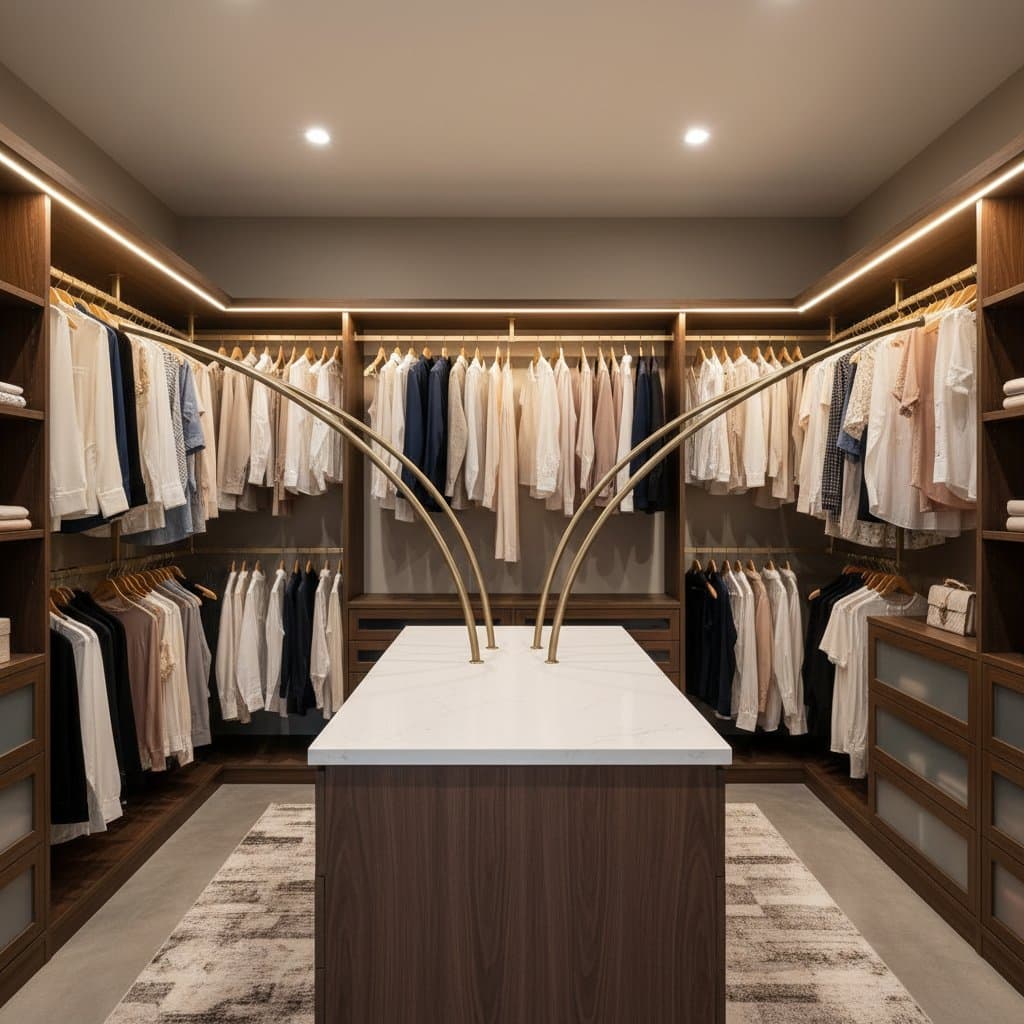
Why Curved Rods Enhance Closet Functionality
Closets often feel confined, with garments pressed together and hard to access. Curved closet rods address this issue by creating additional space and improving organization. These rods gently bow outward, allowing clothes to hang with separation and better visibility.
This upgrade requires no major renovations, only basic tools and a few hours of effort. Homeowners discover that such a modification transforms daily routines, making selection and maintenance simpler. Proceed only if your closet dimensions accommodate the curve without interference from doors or walls.
Essential Considerations
A curved rod extends garments forward from the back wall, which prevents bunching and enhances airflow. This design suits standard reach-in closets measuring at least 24 inches deep and up to 96 inches wide. Verify clearance by measuring the distance from the rod height to the floor and ensuring the arc does not exceed available depth.
Before purchase, assess your wall material, as installation varies between drywall, plaster, or masonry. Adjustable models offer flexibility for non-standard sizes, while fixed lengths provide greater stability for heavier loads.
Required Tools and Materials
Prepare the following items to ensure a smooth process:
- Measuring tape for accurate dimensions
- Level to maintain even alignment
- Pencil for marking positions
- Drill equipped with appropriate bits
- Mounting brackets, typically supplied with the rod
- Screws or wall anchors suitable for your surface type
- Stud finder to locate secure mounting points
- Curved closet rod matched to your closet width
- Optional: touch-up paint to conceal any existing holes
For delicate walls, opt for a manual screwdriver to minimize risk of damage during attachment.
Installation Guide
Follow these steps to install the rod securely and achieve optimal results.
1. Measure the Closet Opening
Determine the interior width from wall to wall using a measuring tape. Note this measurement, as curved rods often adjust within a specific range, such as 48 to 72 inches. Account for at least one inch on each end to accommodate bracket placement.
2. Mark Bracket Positions
Select a height, typically 66 inches from the floor, adjustable based on your longest garments. Use the level to draw straight horizontal lines across both walls at this height with a pencil. Consistent marking prevents the rod from tilting.
3. Locate Wall Studs
Scan each wall with a stud finder to identify solid framing. Mark these spots, as they offer the strongest support. Where studs are absent, select heavy-duty anchors rated for at least 50 pounds per bracket.
4. Create Pilot Holes
Drill shallow holes, about one-quarter inch deep, at each marked point. These guide the screws and reduce splitting in wood or plaster. Clear debris with a soft brush to prepare the surface.
5. Secure the Brackets
Attach brackets by driving screws into the pilot holes. Apply firm pressure and test stability by pulling outward. If the bracket shifts, reinforce with additional anchors or toggle bolts for enhanced hold.
6. Position the Rod
Insert one end of the rod into the first bracket, then extend it to align with the second. Ensure the curve faces forward into the closet space. Secure with set screws or pins provided by the manufacturer.
7. Test with Garments
Suspend several items, such as shirts or pants, along the rod. Observe if hangers distribute evenly without crowding the rear wall. Address any flexing by retightening connections or upgrading to thicker gauge hardware.
8. Repair Previous Mounting Points
For replacing an existing straight rod, apply spackle to old holes. Allow it to set for one hour, then sand smooth. Apply matching paint in thin layers to blend seamlessly.
9. Organize and Evaluate
Reload the closet, grouping items by type or frequency of use. Position bulkier pieces, like coats, toward the center to maintain balance. Compare the new setup to the previous one, noting improved access and reduced clutter.
Best Practices and Common Pitfalls
Recommended Actions
- Measure dimensions multiple times to confirm fit.
- Employ anchors when studs are unavailable for reliable support.
- Empty the closet fully prior to starting work.
- Distribute heavier items along the rod's midpoint to avoid imbalance.
- Select a rod finish that complements surrounding fixtures for visual harmony.
Actions to Avoid
- Attempt to install without verifying bracket compatibility.
- Exceed the manufacturer's specified weight limit, typically 40 to 60 pounds.
- Place near inward-swinging doors that could collide with the curve.
- Neglect leveling, which leads to garments shifting unevenly.
- Overlook surface differences, as improper anchors weaken the entire assembly.
The Mechanics Behind Curved Rods
The design leverages an outward arc to alter weight distribution under gravity. Garments maintain separation, minimizing creases and promoting air circulation to deter odors and mildew.
Interior designer Carla Jensen of SpaceForm Studio notes the visual advantage: "When hangers follow a gentle arc, your eye can scan left to right more naturally." This streamlines morning selections in busy households.
In compact spaces, the curve adds effective depth without structural changes, ideal for closets under 30 inches deep where straight rods cause overlap.
Advantages for Daily Use
The forward projection aligns clothing within your natural reach, spanning hip to shoulder height for effortless retrieval. This positioning eliminates awkward stretches, enhancing comfort during routine tasks.
Occupational therapist Daniel Moore highlights the health benefits: "Any design that brings the object closer to your natural reach reduces tension." Regular use in family closets can lessen fatigue from repeated bending or reaching.
Additionally, the configuration allows light to penetrate further, illuminating rear items and reducing shadows. Natural or fixture light now reaches deeper, aiding quick identification without added illumination.
Selecting Styles and Materials
Available in options like brushed nickel for modern aesthetics, matte black for contrast, or white enamel for seamless integration. Pair with compatible hanger sets to unify the appearance.
Stainless steel withstands moisture in damp environments, whereas aluminum suits lighter-duty applications on softer walls. Telescoping versions adapt to varying widths, while solid pieces demand exact measurements for a flush fit.
In dual-rod systems, apply subtle curves to both levels to prevent interference. For exposed setups, the rod's form introduces elegant contours, softening rigid lines in wardrobe designs.
Situations Requiring Professional Help
Engage a specialist for closets with water damage, unstable walls, or integrated features like electrical outlets. Custom installations involving millwork or reinforced supports benefit from expert assessment to ensure longevity and safety.
Investment and Timeline Overview
Budget $20 to $60 for a basic adjustable rod, with premium variants in durable metals or extended sizes costing up to $100. Hardware comes standard, but specialized anchors add minimal expense.
The process spans one to two hours, extending if repairs or adjustments arise. Factors influencing total outlay include rod specifications and wall preparation needs.
Ongoing Care
- Dust the rod monthly using a soft, dry cloth.
- Inspect fasteners biannually and tighten as necessary.
- Swap anchors promptly if tilting occurs.
- Monitor for wear around attachment points.
- Refresh the finish periodically to combat oxidation.
Properly installed, curved rods endure equivalently to linear counterparts, with the bend posing no inherent durability concerns.
Broader Applications
The principle of forward extension proves versatile beyond closets. Similar curves enhance accessibility in bathroom fixtures, window treatments, and storage units, each optimizing interaction within fixed spaces.
Adapting to Your Upgraded Space
After installation, adjust habits to leverage the new layout, such as rotating seasonal items for even wear. This setup not only saves time but fosters a more intuitive environment, turning storage into a streamlined extension of your routine.