
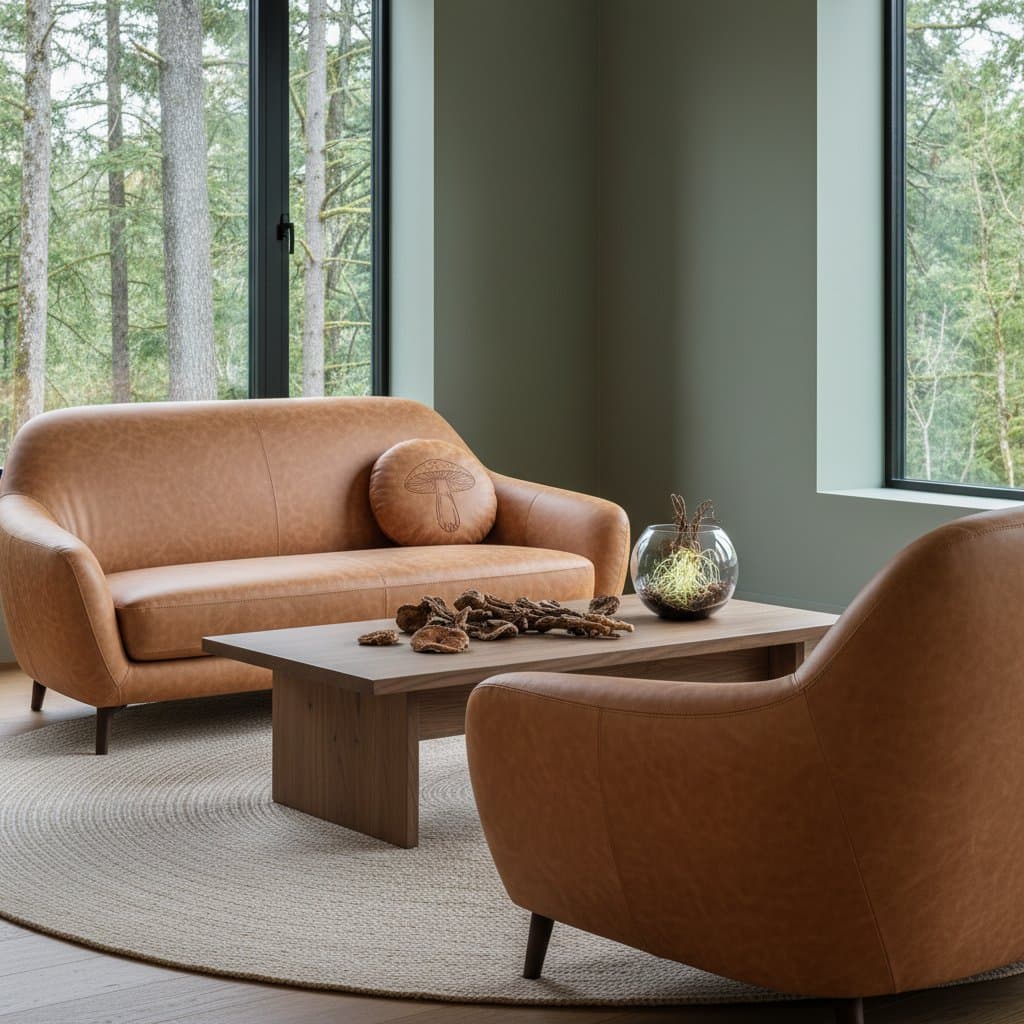
The Emergence of Mushroom Leather in Upholstery
Vegan alternatives have sought to replicate the appeal of traditional leather, but few achieve its depth and resilience. Mushroom leather, derived from mycelium, the root-like network of fungi, changes this dynamic. Initially prominent in fashion, this bio-fabric now enters homes, offices, and creative studios, prized for its environmental benefits and inherent liveliness.
Upholstery producers seek options beyond animal hides and synthetic polymers. Mushroom leather provides a forward-thinking solution that resonates with nature's rhythms.
The Relevance of Mushroom Leather Today
Contemporary homeowners prioritize meaningful luxury over ostentation. Focus has turned to ethical procurement and enduring quality. Mushroom leather aligns with these values: it grows from renewable sources, demands little water, and decomposes naturally at life's end.
This material delivers a subtle sheen akin to fine calfskin, minus ecological costs. Local production further cuts transport-related emissions. Designers highlight its evocative quality, evoking forest vitality that infuses spaces with subtle authenticity.
The Process of Transforming Mycelium into Leather
Production begins with substrates such as corn stalks or wheat straw. Mycelium colonizes this base in regulated environments, forming a sturdy fiber mat in mere days. Harvested sheets undergo compression, natural tanning, and protective treatments.
The outcome resembles versatile leather: customizable through embossing, coloring, or patterning. Growth conditions dictate firmness; lower humidity yields supple suede-like results, while nutrient-rich setups produce robust, saddle-grade sheets.
Companies like MycoWorks and Bolt Threads optimize these methods for reliability and scale. Some specialize in pliable variants for accessories, others in thick panels suited for rigorous furniture demands.
Enhancing Interiors with Unique Texture
Mushroom leather distinguishes itself through immediate tactile allure. It avoids the artificial sheen of synthetics, presenting a soft, warm matte surface. Professionals term this understated elegance, as it diffuses light softly for serene atmospheres.
Palette diversity grows with advanced pigmentation. Initial neutrals like tans and beiges expand to verdant greens, slate tones, and terracotta shades. Pigment integration creates fluid, nature-inspired hues, distinct from uniform leather dyes.
In a personal office refresh, replacing a synthetic chair cover with taupe mushroom leather shifted the room's energy. The piece evolved from generic fixture to artisanal focal point, illustrating material's power to elevate everyday environments.
Performance and Maintenance Essentials
Durability concerns arise, yet premium mycelium withstands wear comparable to bovine leather. It repels moisture effectively and permits airflow, ideal for humid settings where synthetics falter.
Routine care involves mild wiping with a damp cloth. Periodic application of botanical conditioners preserves suppleness. Absent animal-derived oils, it resists cracking under neglect.
Environmental Advantages
Conventional leather demands vast resources: water for rearing, chemicals for processing, and land for grazing. Mushroom leather circumvents these drawbacks. Cultivation consumes minimal water and eschews harmful agents; residues enrich soil as compost.
Assessments reveal reduced carbon footprints versus hides or plastics. Its biodegradability advances closed-loop systems, with offcuts repurposed for future growth cycles by cultivators.
Pricing and Availability Trends
As an emerging option, mushroom leather once commanded luxury premiums for bespoke items. Scaling efforts lower barriers, enabling mid-tier sofa and chair lines from select makers.
Hobbyists access yardage via niche vendors for custom projects like cushions or footstools. Though costlier than basic fabrics, it rivals ethical leathers in value, justified by extended lifespan and minimal upkeep.
Versatile Design Integrations
This material adapts seamlessly across aesthetics, from sleek modernism to earthy traditionalism. Its understated grain enhances clean lines or rustic warmth.
Key uses encompass:
- Seating ensembles: Polished surfaces emulate premium hides in communal areas.
- Table seating: Protective layers ensure resilience against spills.
- Bedroom features: Breathable sections add coziness without excess.
- Decor accents: Wrapped stools or dividers introduce sensory intrigue.
Pairings with oak timbers, cotton weaves, and matte alloys yield harmonious, intuitive designs.
Advances in Coloration and Surface Treatments
Innovations extend beyond base properties. Bio-derived sealants bolster hydrophobicity while retaining decomposability. Experimental varnishes accentuate mycelium's fibrous weave.
Notable collections feature charcoal upholstery with subtle veining, reminiscent of polished rock. Lighter variants employ oil-infused pigments for gentle luster, merging ecology with sophistication.
Everyday Experience with Mushroom Leather
Adopters report profound tranquility from its presence. Free of chemical odors, it subtly adapts to ambient warmth and contact.
A resident shared how her mycelium sofa reshaped family habits. Spills no longer deter use; the surface patinas gracefully, inviting authentic living.
This blend of practicality and invitation underscores its appeal for genuine habitation.
Perspectives from Design Experts
Designer Lena Fischer views mushroom leather as a narrative tool in eco-design. Clients seek authenticity, she observes. Its touch evokes earthbound renewal, forging emotional bonds.
Craftsman Erik Holm adjusts techniques for its nuances: precise cuts and curved joins yield flawless outcomes. The refined drape justifies adaptations, signaling a material paradigm shift.
Incorporating Mushroom Leather into Your Home
Begin modestly with a reupholstered ottoman or side chair to gauge its impact. Opt for versatile shades like beige, sage, or ebony for broad compatibility.
In limited quarters, select pillows or framed panels to infuse vitality. Prioritize verified products ensuring clean production and end-of-life breakdown.
Tailoring to Personal Environments
Natural elements ground any dwelling, and mushroom leather delivers through biological integrity. It unites comfort with planetary stewardship, suiting urban lofts or expansive residences.
Upcoming options promise tailored grains and evolving patinas. Currently, its essence thrives in unadorned form, rooted in organic ingenuity.
Embracing Enduring Craft
Selecting mushroom leather affirms ecological commitment alongside artisanal respect. Subtle marks accrue, mirroring cherished leathers' character, yet with ethical clarity.
True progress in design cultivates belonging. This material facilitates that, weaving renewal into daily rhythms.