
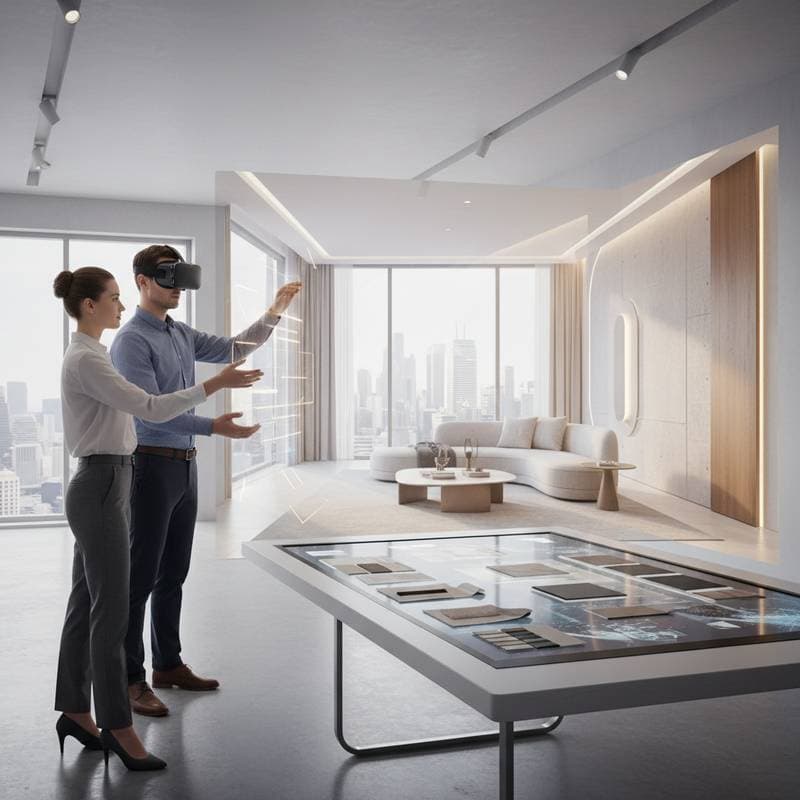
VR Showrooms Transforming Designer Consultations
Flat sketches and two-dimensional plans convey limited aspects of a design vision. Clients often face challenges in picturing how specific fabrics, colors, or layouts integrate into a cohesive space. Virtual reality showrooms address these limitations by enabling designers to guide clients through fully rendered digital environments of homes that exist only in concept. Participants can position themselves within a simulated kitchen or modify lighting in a proposed living room prior to any physical construction.
This technology bridges the gap between imagination and reality, allowing for tangible interactions with proposed designs. Designers leverage VR to demonstrate spatial dynamics and material interactions in ways traditional methods cannot match. As a result, consultations become more dynamic and informed.
At a Glance
- Primary users: Interior designers, architects, and homeowners undertaking renovations or new builds
- Core technology: Headset-driven VR environments combined with web-based 3D walkthroughs accessible via browsers
- Frequently simulated areas: Kitchens, bathrooms, and expansive open-plan living zones
- Investment range: Options include equipment rentals or software subscriptions that align with the expense of one or two standard consultations
- Key objectives: Enhance dialogue precision, boost design accuracy, and strengthen emotional ties between clients and professionals
Traditional Consultations: The Challenges
In conventional design sessions, professionals depend on mood boards, fabric swatches, and basic 2D renderings to communicate ideas. These resources provide initial guidance but frequently leave clients grappling with uncertainties. Descriptions of elements such as warm walnut flooring or subtle sage-painted walls fail to capture interactions with light or scale effectively.
Spatial relationships and overall flow remain abstract, leading to frequent miscommunications. Clients report hesitation in approving plans without a clear sense of the final outcome. For instance, one homeowner shared, “I appreciated my designer’s concepts, yet I could not visualize them fully. Committing felt risky.” Such gaps often result in extended revision cycles and increased project costs.
The VR Advantage: Immersive Exploration
Contemporary virtual showrooms empower clients to engage with complete, lifelike spaces using VR headsets or standard screens on mobile devices and computers. Designers illustrate the impact of design choices, such as how pendant fixtures alter a dining area’s ambiance or how upholstery appears under varying natural light conditions throughout the day.
Users experience environments at actual scale, assessing practical details like the comfort of a 36-inch pathway between a kitchen island and cabinets or the path of sunlight across a room. This immersion fosters immediate feedback and joint decision-making. Professionals observe that VR sessions minimize guesswork, as clients actively contribute insights during the walkthrough.
Revision processes streamline significantly with this method. Rather than exchanging multiple email drafts, adjustments occur in real time within the virtual space. Designers confirm that clients transition from passive observers to engaged participants, leading to more efficient workflows and reduced expenses from post-construction alterations.
Key Design Elements in VR
- Material simulations: High-fidelity digital representations draw from established brands, including Caesarstone for countertops, Benjamin Moore for paints, and Interface for flooring, ensuring true-to-life color and texture accuracy
- Lighting customization: Virtual controls adjust for natural daylight, embedded ceiling lights, and targeted accents, enabling thorough evaluation of atmospheric effects
- Furniture integration: Proportionally accurate models from retailers like IKEA or West Elm allow testing of layouts, ensuring optimal movement and visual balance
- User accessibility: Platforms operate seamlessly on everyday laptops, tablets, or smartphones, eliminating barriers posed by high-end hardware requirements
- Cost management strategies: Professionals frequently recover software expenses by limiting physical revision visits, passing savings to clients through streamlined services
To implement VR effectively, designers recommend starting with a client brief that outlines priorities, such as sustainability or family functionality. During sessions, guide users to focus on one area at a time, like testing cabinet heights in a kitchen simulation. Follow up with annotated screenshots from the VR tour to reinforce discussions and track preferences.
Broader Impacts on Design Practices
Beyond improving communication, virtual tools expand access to expert guidance for diverse audiences. Renters experiment with compact layouts to optimize furniture placement without permanent commitments. Homeowners evaluate eco-friendly options, such as low-VOC paints or recycled materials, through digital trials instead of physical prototypes.
Individuals with limited budgets benefit from the affordability of virtual previews, which deliver the excitement of a guided tour without travel or setup costs. This inclusivity encourages broader experimentation, from vibrant accent walls to modular storage solutions.
Embracing Virtual Design for Confident Choices
VR showrooms unlock creative potential by permitting risk-free iterations. Test unconventional color schemes, reconfigure room divisions, or sample hardware finishes in a controlled digital realm. This process suits urban apartments seeking multifunctional spaces or rural properties aiming for harmonious indoor-outdoor connections.
Ultimately, virtual walkthroughs empower users to select elements that resonate personally while aligning with practical constraints. Clients emerge with a profound understanding of their future living environment, ready to proceed with construction that reflects their refined vision. This evolution in design methodology ensures spaces that enhance daily life from the outset.