
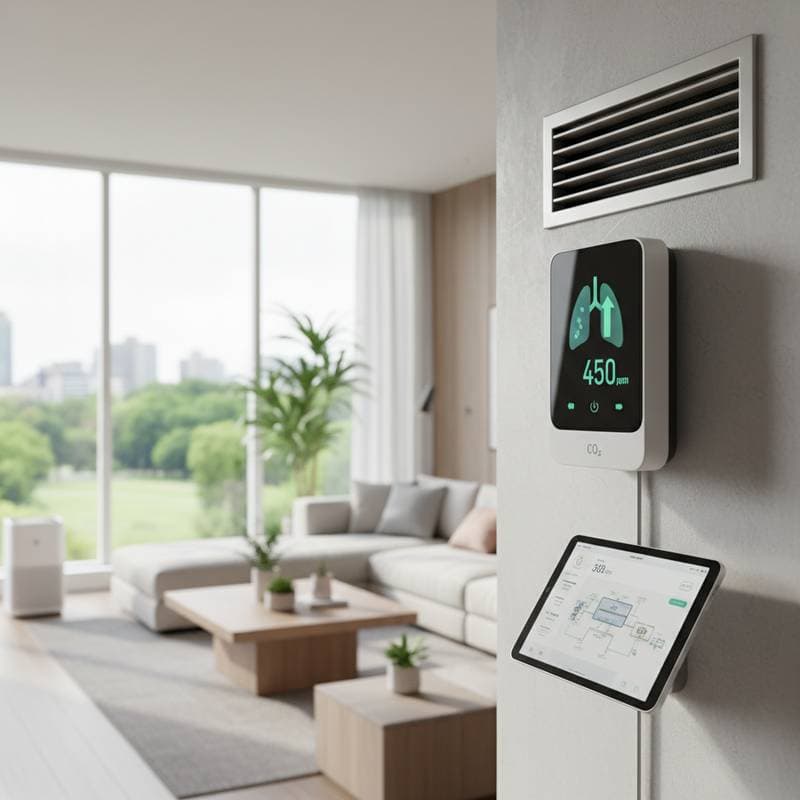
Why CO2 Sensors Have Become Standard in Home HVAC Systems
A comfortable home extends beyond temperature control and aesthetic choices. It includes the quality of air residents breathe daily. As homes achieve greater airtightness for energy conservation, indoor air quality emerges as a key factor in promoting health. CO2 sensors address this need. Previously common in commercial spaces like offices and labs, these devices now integrate routinely into residential HVAC systems. They monitor air composition and enable precise ventilation adjustments.
The Challenge of Poorly Ventilated Indoor Spaces
People spend significant time indoors, often with windows sealed to preserve heating or cooling. Carbon dioxide accumulates from respiration, particularly in enclosed areas. Symptoms such as afternoon fatigue, headaches, or a perception of stuffy air often stem from high CO2 concentrations rather than issues with temperature or moisture levels.
Conventional HVAC setups relied on preset timers or basic thermostat inputs. These methods overlooked actual air quality variations. Consequently, systems wasted energy and delivered uneven comfort. CO2 sensors resolve this by providing real-time data for informed operation.
Principles of CO2 Sensor Operation
CO2 sensors quantify carbon dioxide levels in the atmosphere, expressed in parts per million. When concentrations exceed predefined thresholds, the sensor prompts the HVAC to introduce fresh outdoor air. This responsive mechanism sustains healthy air while minimizing excess energy consumption.
Consider a scenario where family members assemble in the living room for evening entertainment. CO2 levels rise rapidly due to collective breathing. The sensor registers the elevation and activates ventilation to restore balance. Once occupants disperse, the system reduces airflow to optimize efficiency. All adjustments occur seamlessly, without user intervention.
Contemporary residential units predominantly employ NDIR technology. This method involves passing infrared light through an air sample and detecting absorption by CO2 particles. Greater absorption indicates higher CO2 presence, ensuring accurate and durable performance.
Reasons for Adoption by Builders and Residents
-
Enhanced indoor health. High CO2 levels indirectly indicate inadequate ventilation, which permits buildup of other contaminants. Sensor-driven systems deliver oxygen-enriched air that fosters concentration and overall vitality.
-
Improved energy use. Ventilation activates based on demand rather than continuous operation of fans or exchangers. This selective strategy cuts energy loss while upholding comfort standards.
-
Alignment with regulatory updates. Emerging building regulations emphasize air quality indicators alongside traditional airflow measures. CO2 sensors simplify compliance for construction professionals and performance validation for owners.
-
Seamless smart home integration. Advanced HVAC interfaces combine CO2 data with metrics like temperature, humidity, and occupancy. Homes thus adapt dynamically to daily patterns.
Practical Implementation in Varied Home Sizes
In compact, energy-efficient dwellings such as one-bedroom apartments, CO2 sensors prove especially valuable. Activities like cooking or cleaning elevate levels swiftly in low-leakage structures. The sensor triggers targeted airflow increases, alleviating stuffiness without eroding insulation benefits.
Larger family residences benefit similarly, notably in isolated bedrooms during sleep hours. Maintaining CO2 below 1000 ppm supports restorative rest and sharper mornings. These incremental enhancements accumulate into substantial long-term gains.
Selecting and Incorporating a CO2 Sensor
Retrofitting an existing HVAC with a CO2 sensor involves minimal complexity. Wall-mounted units typically link to controllers via low-voltage connections. Position one sensor per primary zone or level for effective coverage.
Key features to evaluate include:
- Self-calibrating mechanisms: Maintain precision without frequent manual adjustments.
- Integrated displays: Allow monitoring of air quality fluctuations.
- Connectivity options: Ensure compatibility with thermostats or automated controls.
Reputable manufacturers such as Honeywell, Airthings, and Siemens provide models suited for homes. These options deliver reliable accuracy at reasonable prices, comparable to standard appliances.
Upkeep and Durability Considerations
CO2 sensors demand scant maintenance. Periodic exterior cleaning removes dust accumulation. Recalibrate every few years if discrepancies appear in readings. Units generally function effectively for five to ten years before requiring replacement, a process akin to updating a thermostat.
For systems paired with energy recovery ventilators or heat recovery ventilators, verify sensor compatibility. Proper synchronization enhances both air purity and operational efficiency.
Experiencing the Benefits Post-Installation
After integration, improvements manifest gradually yet consistently. Homes often feel fresher, with reduced morning lethargy and extended viability of sealed windows. The HVAC operates unobtrusively, harmonizing health, comfort, and resource use.
Data visibility adds reassurance for some users. Observing CO2 reductions following ventilation cycles confirms system efficacy. This transparency demystifies air management, empowering informed oversight.
Steps to Integrate CO2 Monitoring into Your Home
Prioritize CO2 sensors if health, focus, and efficiency matter in your living space. This upgrade accommodates diverse budgets and residences, from urban apartments to suburban homes. The core advantage remains universal: superior air supports enhanced living.
View ventilation as integral to home design, akin to illumination or spatial arrangement. CO2 sensors transcend mere measurement. They enable environments attuned to occupant requirements, fostering spaces that actively contribute to well-being.