
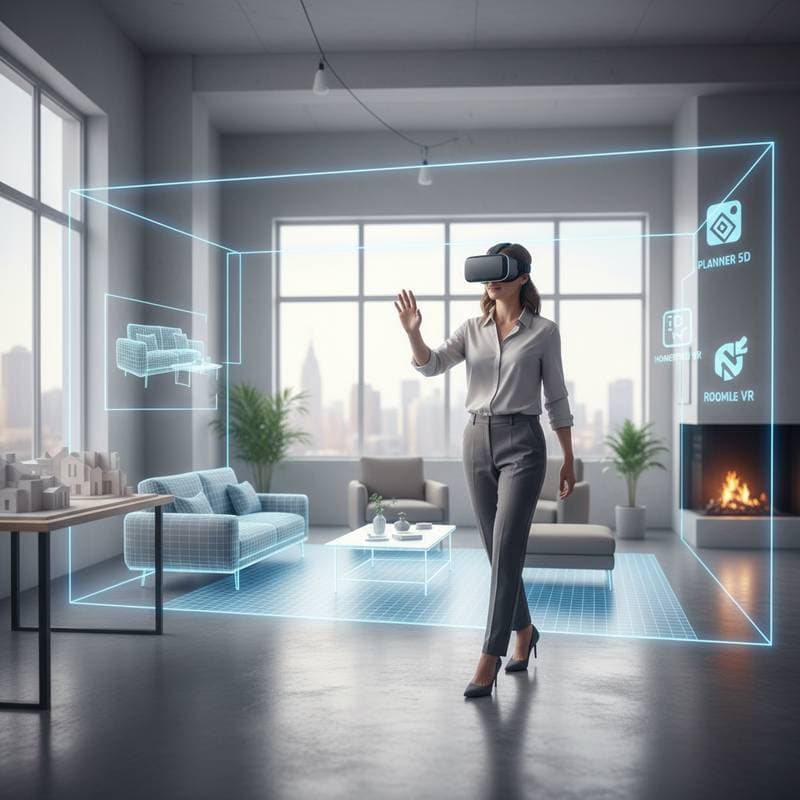
VR Revolutionizes Room Planning Beyond Floor Plans
Visualizing furniture placement in a new space or predicting the impact of wall colors presents significant challenges in interior planning. Traditional floor plans limit this process to two dimensions, restricting the ability to assess spatial dynamics fully. Virtual reality overcomes these limitations by enabling users to navigate designs immersively, evaluating every perspective without initial investments in materials or furnishings.
This guide examines the ways virtual reality elevates room planning past conventional blueprints. It details the evaluation process for prominent tools, presents leading recommendations, and offers guidance for selecting an appropriate virtual reality solution for upcoming projects.
Evaluation Methodology
To assess the effectiveness of virtual reality in enhancing room planning, the review process examined multiple design platforms through a systematic framework. Evaluations centered on five essential criteria:
- Ease of Use: The intuitiveness of the interface for both novice and experienced users.
- Realism and Accuracy: The lifelike quality of visualizations, encompassing lighting, textures, and proportional fidelity.
- Customization Options: The breadth of available furniture models, materials, and decorative elements.
- Collaboration Features: Capabilities for real-time sharing and joint design with collaborators.
- Value for Money: Alignment of pricing with delivered features, performance, and precision.
Testing involved creating designs for diverse room configurations, ranging from small apartments to expansive living areas. The objective was to determine how adeptly these platforms convert floor plans into navigable three-dimensional environments that inform superior design outcomes.
Leading Virtual Reality Tools for Room Planning
1. Best Overall: Planner 5D with VR Mode
Why It Excels: This platform delivers an optimal blend of accessibility, visual authenticity, and adaptability, suiting homeowners and professionals equally.
Pros:
- Straightforward drag-and-drop functionality
- Authentic lighting and material simulations
- Compatible with various devices
- Extensive collection of furniture and surface options
Cons:
- Fewer advanced modeling capabilities for specialists
In-Depth Assessment:
Planner 5D effectively connects basic usability with refined capabilities. In evaluations, importing a two-dimensional floor plan and transitioning to three-dimensional virtual exploration proved seamless. The virtual reality mode facilitated physical navigation via headset, allowing precise evaluation of proportions, arrangements, and circulation patterns. Renderings accurately depicted nuanced light variations and reflective qualities, empowering users to refine choices with assurance. Although it may lack depth for complex professional needs, Planner 5D provides an effective, user-friendly method for room visualization.
2. Best for Collaboration: Homestyler VR
Why It Excels: Advanced cloud-based sharing enables seamless real-time collaboration on virtual designs.
Pros:
- Instantaneous teamwork and annotation tools
- Comprehensive, frequently refreshed product database
- Effortless synchronization with mobile platforms
Cons:
- Dependence on reliable internet for optimal operation
In-Depth Assessment:
Homestyler VR adopts a collaborative framework for interior design. Several participants can engage simultaneously, adding feedback and adjusting elements collectively. Testing highlighted the utility of this for design groups or households coordinating on communal areas. Virtual reality traversals operated fluidly, with light modeling offering dependable insights into ambient and fixture influences on atmosphere. Performance hinges on consistent connectivity, potentially restricting disconnected applications, yet its teamwork prowess positions it ideally for shared endeavors.
3. Best for Realism: Roomle VR
Why It Excels: It provides the most precise and engaging visualizations, ideal for professional-level rendering.
Pros:
- High-resolution outputs with authentic physical simulations
- Compatibility with intelligent furniture manufacturers
- Superior adherence to actual dimensions
**Cons:**n- Initial acclimation required for newcomers
- Elevated costs for enhanced functionalities
In-Depth Assessment:
Roomle VR distinguished itself through environments that mirror reality in lighting and materiality with exceptional detail. Navigating a simulated room conveyed tangible sensations in flooring and textiles. Partnerships with furniture providers allow scaled previews of genuine items, minimizing purchase errors. Interior specialists and architects benefit profoundly from this accuracy. New users might invest time mastering controls, but Roomle VR remains unmatched for those seeking superior visual integrity and expert outcomes.
Key Considerations for Selecting Virtual Reality Room Planning Tools
Ease of Use
Select a platform aligned with your expertise. Novices benefit from uncomplicated layouts featuring drag-and-drop mechanics, whereas experts prefer systems with sophisticated editing and output controls. Experiment with trial versions to gauge suitability prior to subscription.
Realism and Rendering Quality
Superior visual fidelity enhances spatial assessment. Prioritize applications that faithfully simulate illumination, surface qualities, and shadow effects. Such precision bolsters confidence in design selections.
Compatibility
Verify alignment with your virtual reality equipment, computing setup, or mobile device. Certain tools function across broad hardware ranges, while others demand robust specifications for peak results. This ensures software value complements existing resources.
Library and Customization
Diverse inventories of furnishings, coatings, and palettes foster innovation. Optimal platforms maintain current trend-aligned selections and collaborate with authentic brands for precise product integration.
Collaboration Tools
For projects involving designers, builders, or relatives, shared editing, annotations, and remote storage streamline interactions. These elements accelerate consensus and implementation.
Value and Subscription Models
Costs among virtual reality planning solutions differ widely. Basic access may come without charge, with escalations for advanced options, or necessitate recurring fees. Weigh usage frequency against feature benefits to determine worth.
Enhancing Designs with Virtual Reality Insights
Virtual reality augments traditional planning by adding experiential depth to measurements. Users gain comprehensive perspectives on functionality and aesthetics, leading to more informed investments. Integrate these tools to streamline decisions and achieve spaces that align precisely with visions.
Common Queries on Virtual Reality Room Planning
Does virtual reality fully supplant conventional floor plans?
It complements rather than replaces them. Floor plans supply exact dimensions, whereas virtual reality imparts volumetric comprehension. Combined, they yield thorough evaluations of practical design performance.