
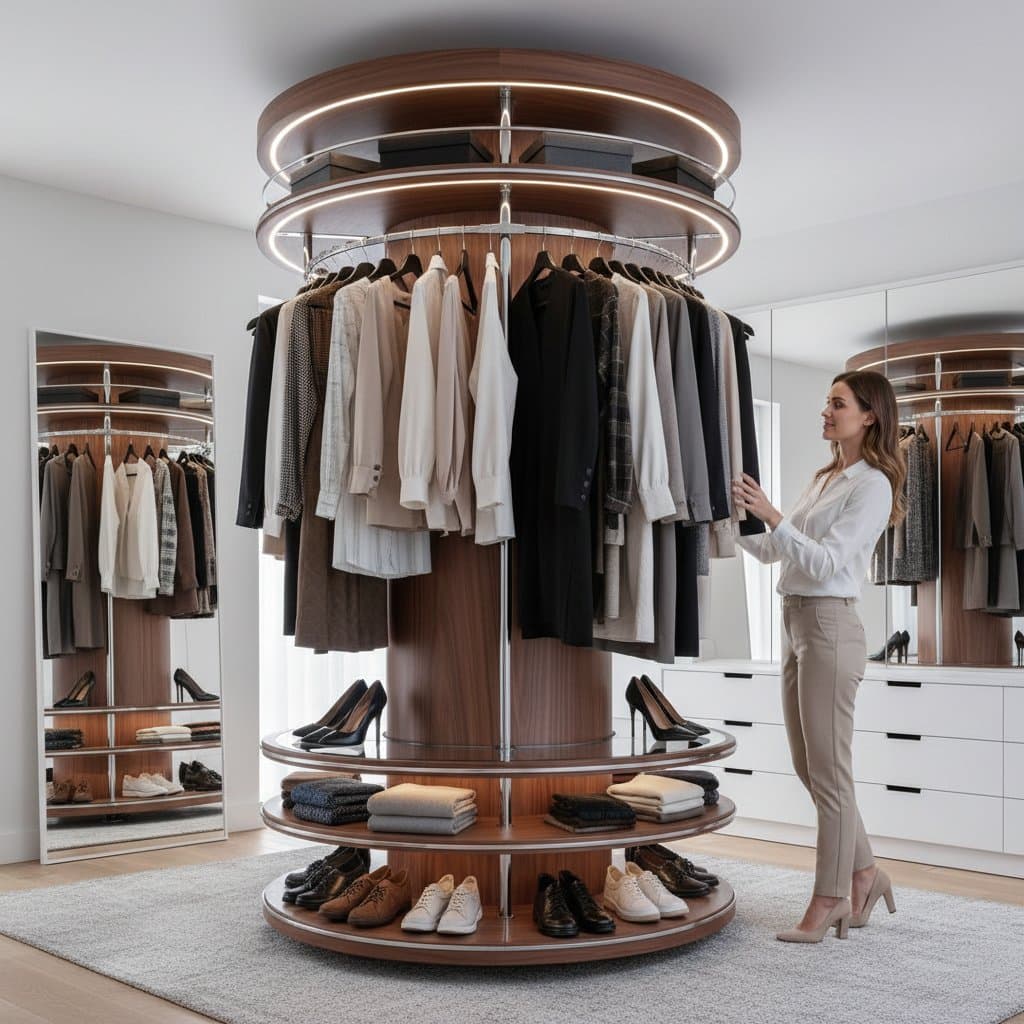
Why Motorized Carousel Closets Outperform Static Shelves
A motorized carousel closet provides complete access to an entire wardrobe without the need for rummaging, stacking, or excessive bending. This innovative system converts underutilized corners into fully accessible areas and ensures garments remain wrinkle-free and ready for immediate use.
Static shelves often lead to disorganized piles and hidden items. In contrast, a rotating closet delivers selections directly to the user with minimal physical strain.
This article examines the operational principles of these systems, anticipated costs and maintenance needs, and scenarios requiring professional installation.
One important consideration involves structural compatibility; not every closet accommodates the weight or electrical demands, so evaluate wall and floor integrity prior to proceeding.
Essential Considerations
A motorized carousel closet employs a rotating rail or rack system that circulates clothing in a continuous loop activated by a simple button press. This design maximizes space utilization and minimizes visual clutter by maintaining even spacing and visibility for all items. Primary limitations include the necessity for reliable power sources and sufficient ceiling clearance. Verify that walls and mounting points support the designated load capacity to prevent structural failures or safety hazards.
Required Tools and Materials
- Measuring tape for precise dimensions
- Stud finder to locate secure attachment points
- Access to a power outlet or electrical wiring
- Mounting brackets and appropriate screws
- Level to ensure even installation
- Soft cloth or microfiber duster for routine cleaning
- Light lubricant suitable for mechanical components
In environments with restricted wiring, consider battery-operated or manual-rotation alternatives, although these options typically operate at reduced speeds compared to fully motorized units.
Installation Guide
1. Measure the Available Space
Determine the height from floor to ceiling and the width between opposing walls. Allocate a minimum of two inches of clearance surrounding the entire carousel path to accommodate smooth operation.
2. Identify Studs and Electrical Outlets
Employ a stud finder to pinpoint robust mounting locations. Secure the frame to at least two structural studs for stability. Confirm proximity to an electrical outlet or a safely accessible wiring line.
3. Assemble the Frame Structure
Adhere strictly to the manufacturer's assembly instructions. Tighten all bolts uniformly to avoid imbalances. An inadequately secured frame may result in irregular rotation or operational noise over time.
4. Install the Motor Unit
Position the motor at approximately shoulder height to facilitate future maintenance. Fasten it securely with screws driven into studs, avoiding reliance on mere drywall anchors.
5. Secure the Rails or Racks
Insert the rails into the motor hub and manually verify rotation prior to electrical connection. Correct any misalignments to eliminate potential friction or binding during use.
6. Connect Power and Conduct Initial Tests
Attach the unit to a power source or integrate it with a dedicated circuit. Activate the carousel at its lowest speed setting. Observe for vibrations, wobbling, or unusual sounds indicating issues.
7. Distribute Items Evenly
Arrange clothing or storage boxes across balanced sections of the rack. Uneven loading can impose excessive strain on the motor or cause instability in the assembly.
8. Incorporate Safety Features
Standard systems feature obstruction sensors that automatically stop movement upon detecting blockages. Perform thorough tests of these mechanisms before regular operation.
9. Establish Cleaning and Adjustment Routines
Remove dust from rails on a monthly basis. Apply a small amount of lubricant to bearings if rotation becomes sluggish or produces squeaking noises.
Recommended Practices and Precautions
Recommended Practices
- Measure dimensions meticulously prior to purchasing components.
- Distribute heavy and lightweight items evenly throughout the rack.
- Inspect wiring for safety compliance before making connections.
- Maintain clean and dry rails to preserve functionality.
- Conduct a brief tune-up at the start of each season.
Precautions to Avoid
- Exceed the manufacturer's specified weight capacity.
- Apply cleaning sprays directly to the motor housing.
- Suspend wet garments, as moisture promotes rust on metal components.
- Disregard indications of sluggish or irregular movement, which suggest loose connections.
- Disable or circumvent integrated safety switches.
Scenarios Requiring Professional Assistance
Engage a licensed installer if closet walls lack sufficient thickness, if electrical wiring requires extension, or if the unit exhibits instability under load. Professionals assess structural adequacy and guarantee safe motor integration. Immediate action is essential upon detecting electrical odors, sparks, or excessive heat from the housing; disconnect power and summon a qualified technician without delay.
Cost and Timeline Overview
Entry-level single-rod carousel units typically cost between $300 and $800. Comprehensive wardrobe systems, incorporating robust motors and premium finishes, range from $1,500 to $4,000. Basic installations require two to four hours in a standard closet space. Additional expenses and time arise from electrical modifications or structural reinforcements. Factors such as motor power, overall dimensions, and material quality primarily influence pricing variations.
Ongoing Maintenance Procedures
- Wipe metal surfaces monthly to eliminate dust accumulation.
- Lubricate pivot joints biannually to ensure smooth performance.
- Inspect the power cord and plug regularly for signs of deterioration.
- Clean the sensor lens periodically to maintain precise detection.
- Re-secure mounting screws upon noticing any rattling sounds.
Should the carousel demonstrate hesitation or reduced speed, unload all items and test the motor in an empty configuration. Persistent drag indicates the need for bearing or belt replacement by a specialist.
Insights from Industry Experts
Maria Kent, a certified closet designer at SpaceSmart Interiors, states, "A motorized carousel excels in environments with limited reach or expansive closet depths, as it eliminates inaccessible upper and corner areas." She advises selecting models equipped with manual override capabilities for reliable operation during power failures. Kent further highlights that these rotating setups minimize fabric creasing, allowing garments to hang freely without the compression associated with stacked shelving.
Implementing Your Carousel System
Begin with a compact unit to familiarize yourself with its operational flow. As the enhanced visibility and accessibility of your wardrobe become evident, consider scaling up or tailoring the configuration to specific needs. Ultimately, a motorized carousel closet streamlines morning routines, fosters a serene environment, and elevates overall wardrobe management efficiency.